Data sources Config-dependent
Document every enabled provider, its permitted use, retrieval timing, field provenance, and refresh behavior. Public-source context and enrichment output should not be presented as equivalent evidence.

Agent-native prospecting · evidence first
Give your AI agent an ICP, a territory, and the evidence standard. PhantomBuster returns structured research with source context and review states—without forcing another seat-based workspace into your stack.
Copying is step one; you still run and configure the skill in your agent.
npx -y @okki-global/okki-go-taroball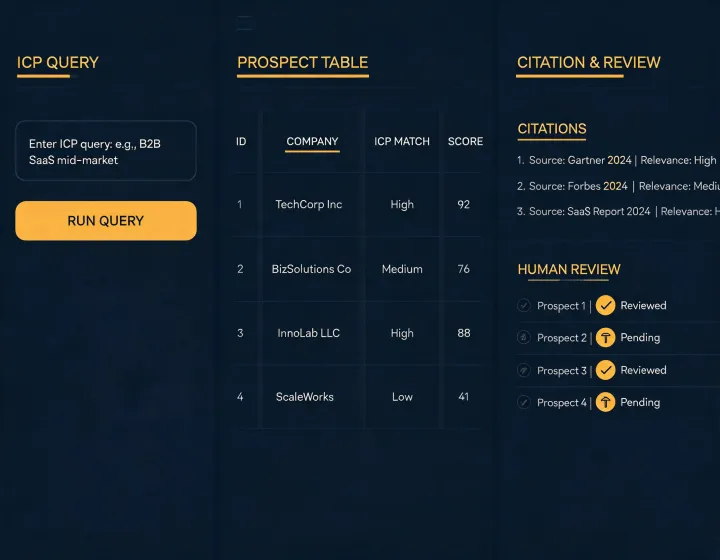
Dated comparison
Public claims change. This table records what can be checked, what depends on configuration, and what remains undisclosed as of 20 July 2026.
| Dimension | Browser and API workflow | Conventional seat SaaS | Evaluation question |
|---|---|---|---|
| Setup path | Install inside an existing agent | Account and workspace onboarding | Where does daily work occur? |
| Task model | Natural-language, task scoped | UI workflow and saved filters | Can the method be reproduced? |
| Human review | Explicit approval checkpoints | Config-dependent | Who approves targeting and sending? |
| Data disclosure | Source context in result | Varies by provider | Can a reviewer trace the record? |
| Cost model | Runtime and provider dependent | Usually seat or credit based | Which unit drives marginal cost? |
| Security detail | Inspect permissions before running | Review vendor documentation | Where are keys and outputs stored? |
“Varies” and “config-dependent” are not negative scores; they indicate facts that require environment-specific verification.
Method milestones
Write the ICP, territory, exclusions, required signals, intended use, and evidence threshold before collecting records.
Attach a source and retrieval time to consequential facts; label transformations and preserve missing fields.
Challenge inferred fit, stale evidence, provider conflicts, suppression, and contact relevance before export or drafting.
Keep message approval and sending outside the research state, with human control and region-specific obligations.
Research notes
Define firmographic, technographic, exclusion, and confidence fields before a search begins.
Inspect relevance, source recency, suppression rules, and regional outreach obligations.
Evaluate seat SaaS, waterfall enrichment, browser automation, and agent-native execution.
Four-state runbook
npx -y @okki-global/okki-go-taroballSuccess signal: the exact command is in your clipboard.
Paste the command into the terminal used by your supported AI-agent environment. Read the package prompt before allowing execution.
Success signal: the installer completes without a package or permission error.
Add only the provider credentials your chosen workflow requires. Keep keys in the runtime secret store; never paste them into prospecting prompts.
Success signal: the agent can enumerate the installed skill without exposing secrets.
Begin with a narrow ICP and request evidence fields. Review sources, uncertain matches, and exclusions before exporting or drafting outreach.
Success signal: a structured sample appears with reviewable provenance.
Data and security ledger
Document every enabled provider, its permitted use, retrieval timing, field provenance, and refresh behavior. Public-source context and enrichment output should not be presented as equivalent evidence.
Keep credentials in the runtime secret manager, restrict scopes, rotate exposed keys, and verify that prompts, logs, screenshots, and exports do not disclose them.
Inspect the package, network destinations, requested permissions, update path, logs, and uninstall behavior in a controlled environment before production use.
Map copies in the agent, provider, cache, export, CRM, and engagement system. Removing a package or revoking a key may not delete downstream records.